Learning & Dynamical Systems
Learning to Hit through Dynamical Systems
The foundational work: learn how an object moves after a strike, then hit it so it slides to a target beyond the robot's reach.
Motivation
In logistics and industry, exploiting impulsive actions (pushing, hitting, throwing) can speed up pick-and-place and let a robot place objects well beyond its natural workspace. Unlike pushing, a hit is instantaneous: the action must be chosen correctly before contact, since there is no chance to adjust once the object is released. Post-impact motion is governed by friction, drag and restitution, all known only approximately.
The inverse problem
The forward problem - predicting where an object ends up given a hit - is easy if the dynamics are known. This paper tackles the harder inverse problem: given an object's initial and desired positions, what initial speed and direction should the robot deliver? It admits several solutions and is complicated by physical uncertainty, so the mapping is learned from data rather than modelled analytically.
Method
- Hitting direction follows directly from the object's initial and target positions on the sliding plane.
- Hitting speed is predicted by a probabilistic model relating hitting angle, end-effector speed and travelled distance, learned as a Gaussian Mixture Model (fit by Expectation-Maximisation, with the number of Gaussians chosen by the Bayesian Information Criterion) and queried via Gaussian Mixture Regression.
- Motion generation uses a provably stable dynamical system with a phantom attractor, so the end-effector reaches the object with the desired non-zero pre-impact velocity regardless of joint configuration - with a global asymptotic stability proof.
Results
A dataset of 60 real hits was collected on a KUKA LBR iiwa 7, spanning commanded speeds in [0, 2.5] m/s and directions in [−0.4, 0.4] rad. BIC selected a 3-Gaussian model; GMR then predicts the hitting speed for new targets. Repeating each desired final position five times, the robot reliably slides a box on a table of unknown friction to the requested location - demonstrating repeatable, workspace-extending manipulation through learned hitting.
Gallery
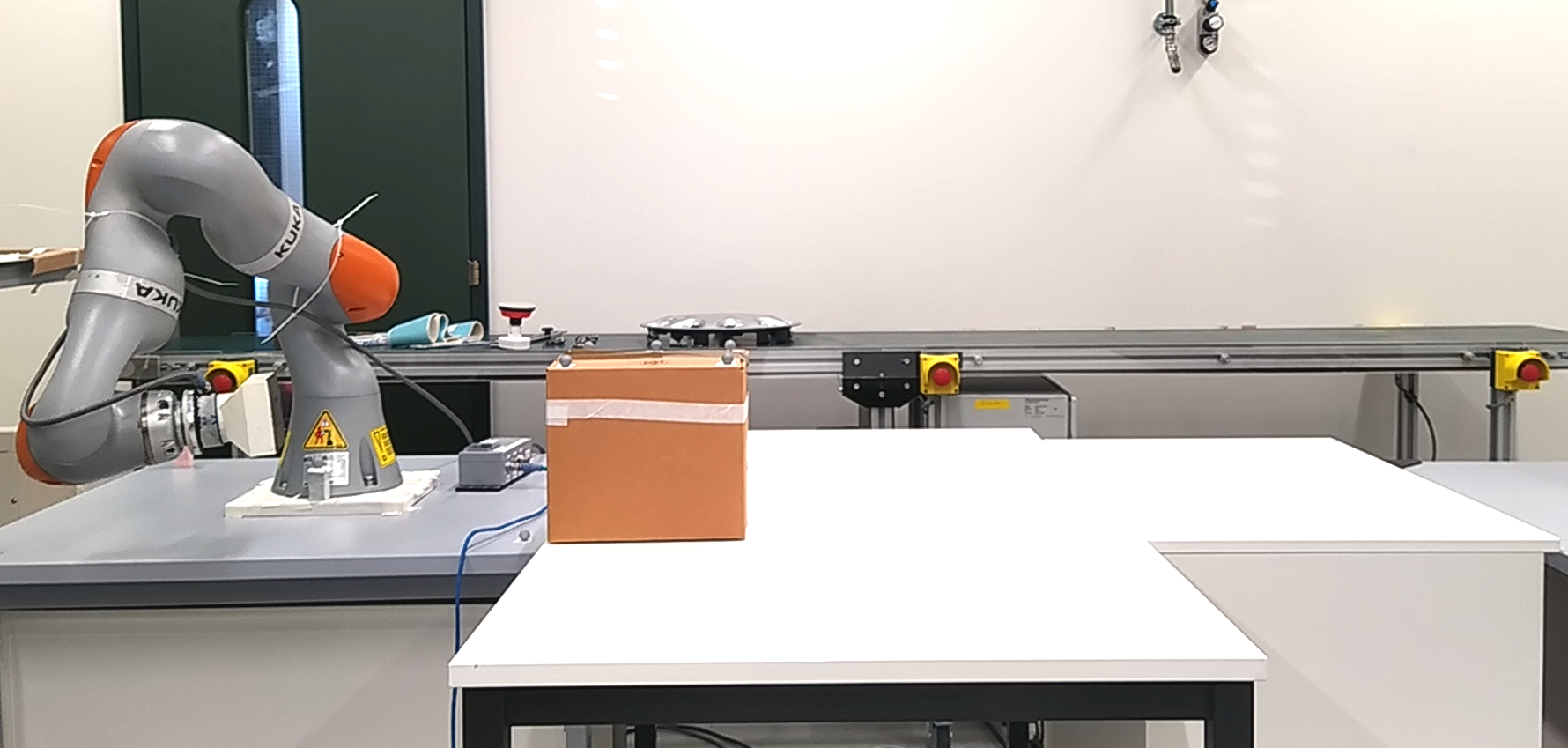
Approach phase
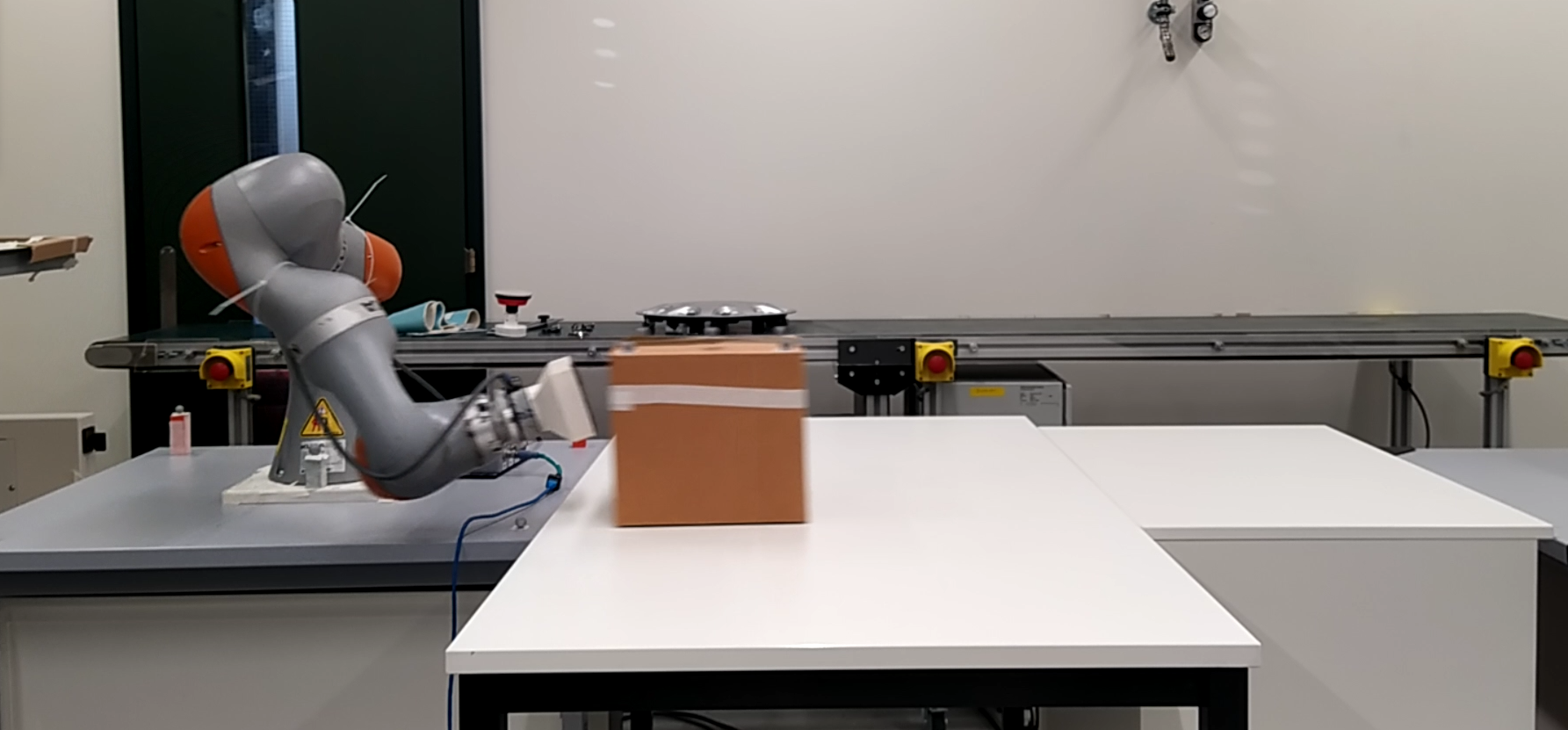
Impact phase
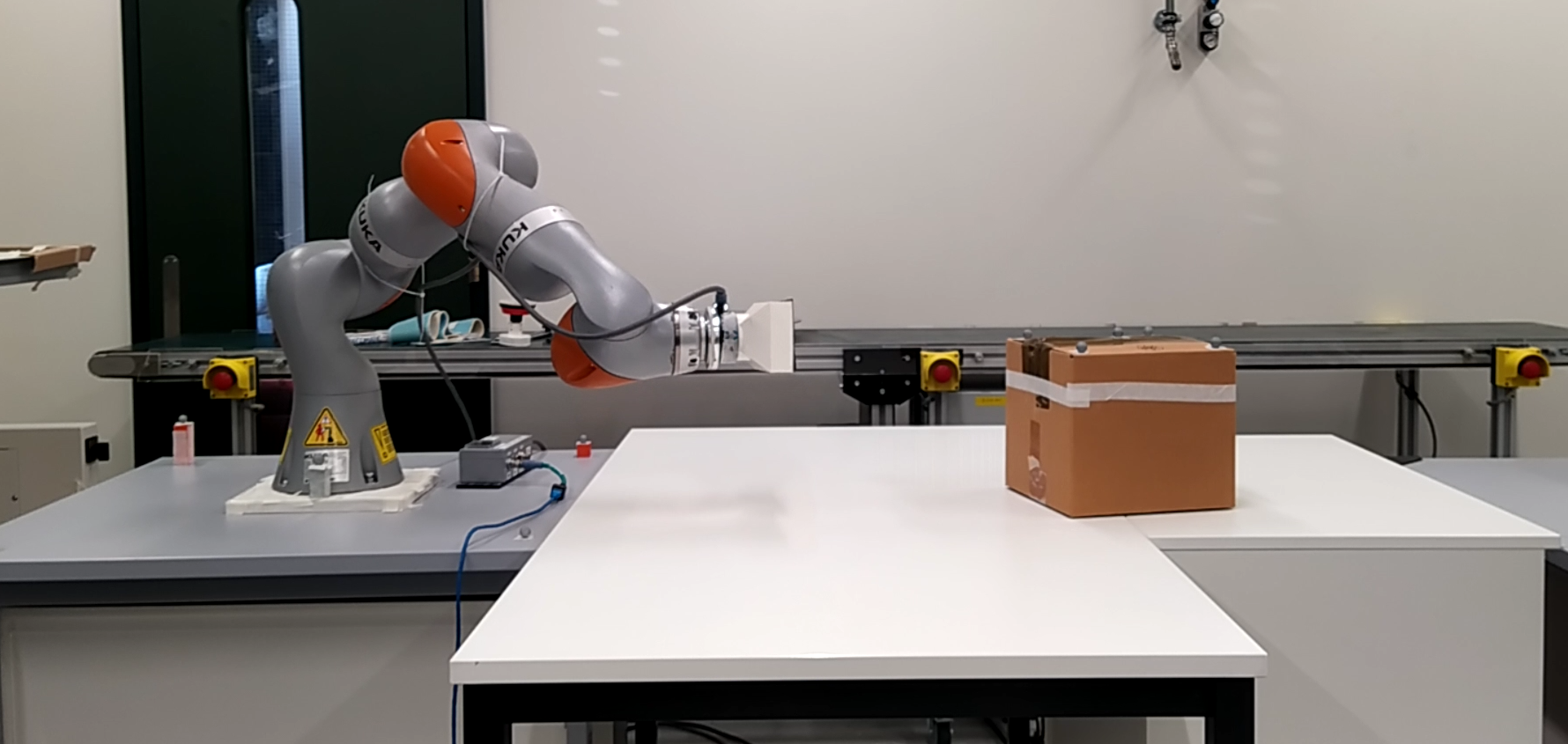
Resulting object motion